 Trendium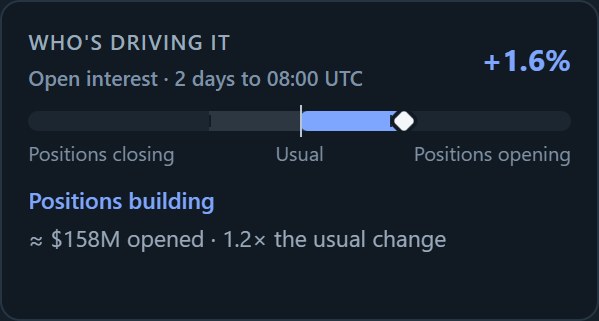
What is open interest?
Open interest is the total of outstanding derivatives contracts that remain open. Trading volume measures contracts traded during a period; open interest measures the contracts still outstanding. They answer different questions, even when shown beside the same price chart.
An increase indicates a larger outstanding contract total, while a decrease indicates a smaller one. For the underlying definition and the distinction from volume, see CME Group’s open-interest explanation.
Does rising open interest mean more buyers than sellers?
No. Every derivatives contract has a long side and a short side. Open interest alone does not reveal which side is more aggressive, whether positions are hedges, or what traders intend. It is not a count of bullish people versus bearish people.
Looking at open interest beside price can help frame questions about participation. It does not turn an aggregate position measure into proof of “smart money,” an identified buyer, or a guaranteed direction.
How Trendium presents this information
Trendium brings open-interest data from three major exchanges into its market reading. Its panel places the change, the period and a plain-language interpretation beside the price and trend information. The screenshot shows a 1.6% increase over two days and the label “positions building.”
The image is a captured example, not current market data. Read the percentage, the dollar context and the period together. Dollar-denominated values can be affected by price as well as position size; avoid treating a dollar change as an exact amount of new cash deposited by traders.
Four combinations worth distinguishing
- Price up, open interest up: price rose while outstanding exposure increased. It does not prove that all new positions are bullish.
- Price up, open interest down: price rose while outstanding exposure decreased. That alone does not prove a short squeeze.
- Price down, open interest up: price fell while outstanding exposure increased. It does not identify who opened which side.
- Price down, open interest down: price fell while outstanding exposure decreased. That alone does not establish a bottom.
These are descriptive combinations, not rules for opening or closing trades. Use the same observation window when making comparisons.
What exchange coverage leaves out
Data from three exchanges is a defined sample, not the entire crypto market. It does not include every venue, every off-exchange position or every spot-market participant. Missing or delayed data can further limit a reading.
Use open interest as one part of a review alongside trend direction, timeframe agreement and risk. If the app reports unavailable data, address the connection or data issue instead of interpreting the gap as market sentiment. See market data support for help.